
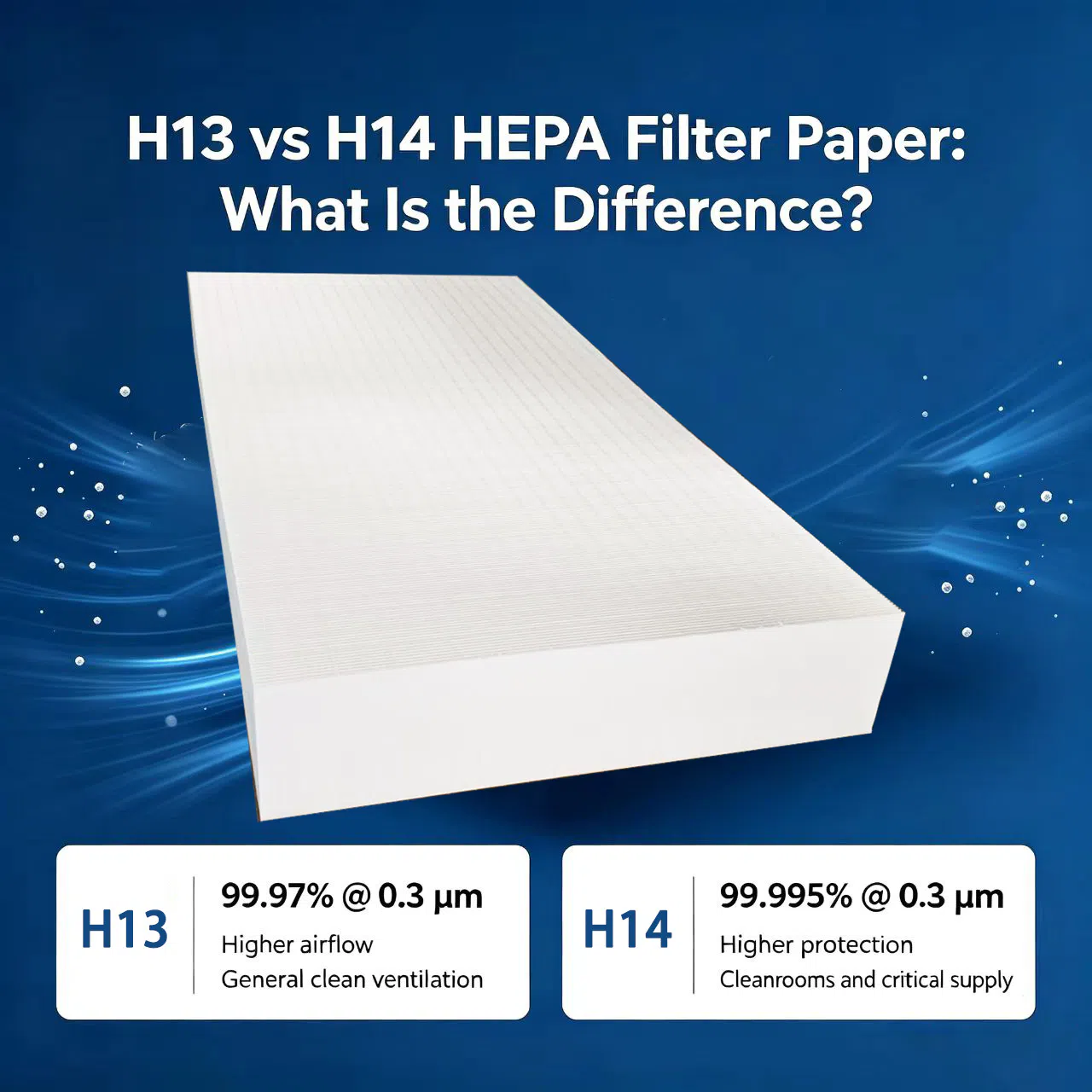
Both H13 and H14 are high efficiency filter classes, but they are not suitable for every application. The right choice depends on filtration efficiency, airflow, pressure drop, filter design, and operating conditions.
For filter manufacturers and OEM buyers, choosing HEPA filter paper based only on filtration efficiency can lead to unnecessary pressure drop or production problems.
This guide explains the main differences between H13 and H14 and how to choose the right HEPA filter paper for your application.
H13 and H14 Efficiency Requirements
What Is the Difference Between H13 and H14?
H13 and H14 represent different levels of high efficiency filtration under the EN 1822 classification system.
Filter Class | Minimum Overall Efficiency | Typical Application |
|---|---|---|
H13 | 99.95 percent | High efficiency air filtration |
H14 | 99.995 percent | Higher efficiency air filtration |
The efficiency is evaluated at the most penetrating particle size, commonly referred to as MPPS.
H14 provides a higher filtration efficiency than H13. However, higher efficiency does not automatically mean that H14 is the best choice for every filter.
The final filter performance also depends on filter construction, airflow, filter area, pleat design, sealing, and other factors.
Is H14 Always Better Than H13?
Not necessarily.
H14 provides a higher filtration level, but the required efficiency should be determined by the actual application and system requirements.
For example, if an application requires H13 performance, using a higher grade may not provide enough additional benefit to justify changes in pressure drop, airflow, filter cost, or system design.
The main question should therefore be:
Which efficiency level is required for the finished filter?
For filter manufacturers, this is more important than simply choosing the highest available efficiency.
Why Does the Difference Matter to Filter Manufacturers?
When selecting HEPA filter media, manufacturers need to consider the complete filter design.
Important factors include:
- Required filtration efficiency
- Airflow
- Initial pressure drop
- Filter dimensions
- Pleat depth
- Pleat spacing
- Filter surface area
- Mechanical strength
- Production process
A professional HEPA filter paper supplier should be able to provide technical data and samples to help manufacturers evaluate the media before mass production.
Pressure Drop, Airflow and Filter Design
Filtration efficiency is only one part of HEPA filter performance.
When selecting H13 HEPA filter paper or H14 HEPA filter paper, buyers should also pay close attention to air permeability and pressure drop.
What Is Pressure Drop?
Pressure drop is the resistance that air experiences when passing through the filter.
A higher pressure drop means that the air handling system may need more energy to maintain the required airflow.
For this reason, the ideal HEPA filter media should provide a balance between:
- High filtration efficiency
- Suitable air permeability
- Low and stable pressure drop
- Adequate mechanical strength
- Reliable production performance
The pressure drop of the finished filter is affected by more than the filter paper itself. Airflow, filter area, pleat configuration, and filter construction can also have a significant effect.
How Does Filter Design Affect Performance?
The same HEPA filter paper may perform differently when used in different filter designs.
Filter Design Factor | Effect on Performance |
|---|---|
Airflow | Higher airflow can increase pressure drop |
Filter surface area | More area can reduce air velocity through the media |
Pleat depth | Affects effective filtration area |
Pleat spacing | Influences airflow distribution |
Filter dimensions | Determines available media area |
Sealing | Affects leakage and finished filter performance |
Filter construction | Influences airflow and mechanical stability |
This is why filter manufacturers should evaluate HEPA filter media together with the finished filter design.
What Should You Ask a HEPA Filter Paper Supplier?
Before placing a bulk order, buyers should request detailed technical information.
The key specifications include:
Filtration efficiency
Air permeability
Pressure drop
Media thickness
Basis weight
Tensile strength
Burst strength
Roll width
Roll length
Test method and test conditions
It is also recommended to request samples before mass production. Testing the media on your own production equipment can help confirm pleating performance, airflow, pressure drop, and mechanical strength.
Looking for H13 or H14 HEPA Filter Paper?
For filter manufacturers, stable supply and consistent quality are essential for long-term production.
As a professional HEPA filter paper supplier, we provide filter media for different filter designs and OEM production requirements.
Our support includes:
- Consistent media quality for regular production
- Flexible roll widths and specifications
- Technical data for product evaluation
- Samples for production testing
- OEM and bulk supply support
- Technical assistance with media selection
The right filter media can help you achieve the required filtration performance while maintaining suitable airflow and production efficiency.
Welcome to contact us to Request a Quote | Get a Sample


