
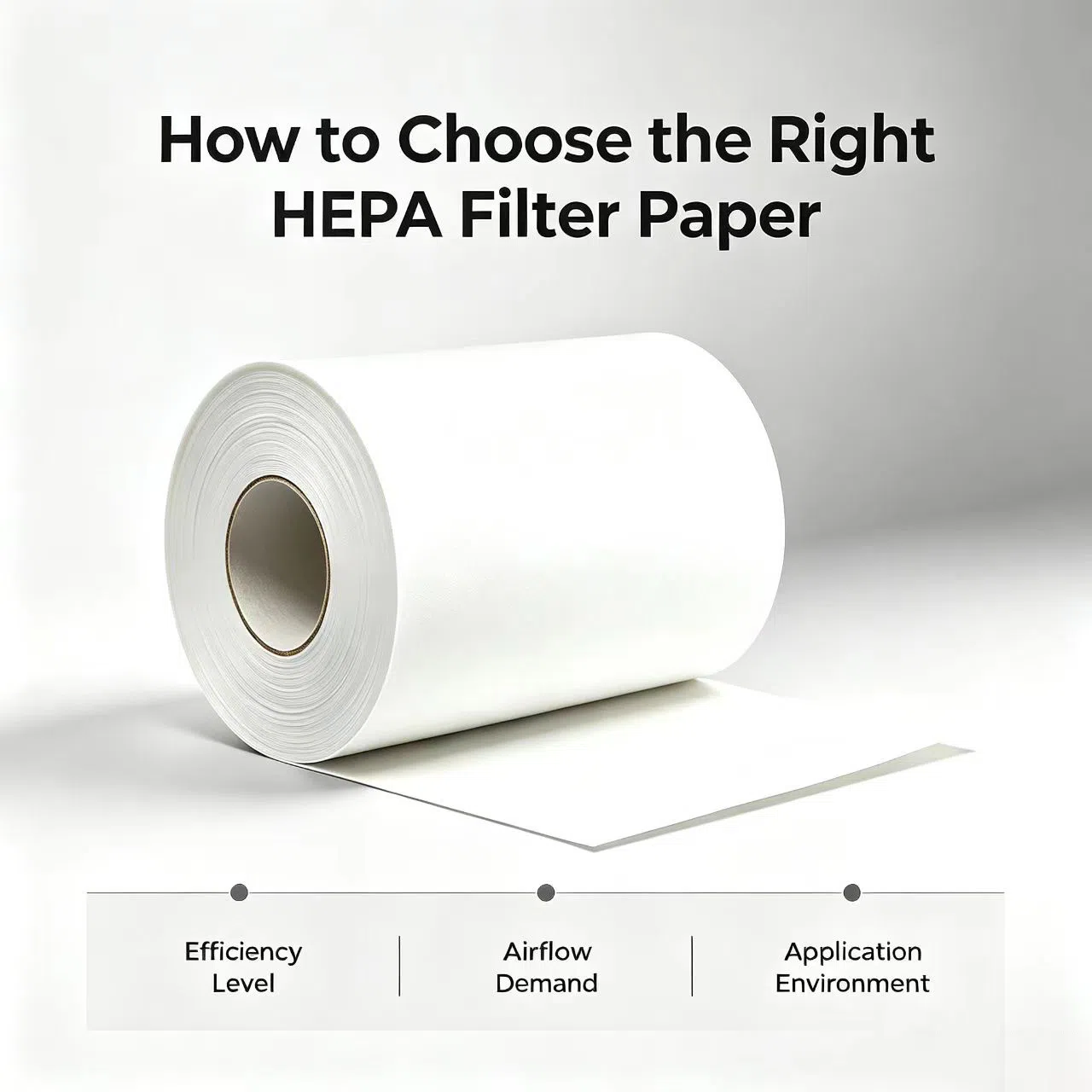
Choosing the right HEPA filter paper is important for filter manufacturers, HVAC companies, and industrial filtration suppliers. The highest filtration efficiency is not always the best choice. A suitable HEPA filter media should provide a balanced combination of filtration efficiency, air permeability, pressure drop, mechanical strength, and production performance.
Before placing an order, buyers should understand the key specifications and make sure the media is compatible with their filter design and manufacturing process.
Check the Key Specifications of HEPA Filter Paper
The first step is to identify the technical requirements of the finished filter. Different applications require different media performance.
Key Specifications to Compare
Specification | What It Means | Why It Matters |
|---|---|---|
Filtration Efficiency | The ability to capture particles | Determines the required filtration performance |
Air Permeability | How easily air passes through the media | Affects airflow and filter resistance |
Pressure Drop | Resistance to airflow | Influences fan energy consumption |
Thickness | Thickness of the filter media | Affects pleating and filter construction |
Basis Weight | Media weight per unit area | Influences structure and consistency |
Tensile Strength | Resistance to pulling forces | Important during pleating and handling |
Burst Strength | Resistance to mechanical damage | Helps prevent media damage during production |
Moisture Resistance | Ability to withstand humidity | Important for humid operating environments |
Filtration Efficiency
Filtration efficiency is one of the most important specifications for HEPA applications.
Under the EN 1822 classification system, H13 and H14 filters have minimum overall efficiencies of 99.95 percent and 99.995 percent at the most penetrating particle size.
The final filter performance depends on several factors, including:
Filter media
Pleat design
Filter area
Sealing method
Airflow
Therefore, a supplier should provide detailed media test data instead of simply describing a roll of filter paper as "H13" or "H14."
Air Permeability and Pressure Drop
Air permeability and pressure drop are closely related to airflow performance.
A highly efficient media may have greater airflow resistance. Excessive pressure drop can increase the energy required to operate the filtration system.
When comparing different HEPA filter papers, buyers should check:
Airflow test conditions
Pressure drop
Air permeability
Media thickness
Target filtration efficiency
The goal is not simply to obtain the highest efficiency. The goal is to achieve the required efficiency with an acceptable pressure drop.
Match the Filter Paper to Your Filter Design
The same HEPA filter paper may perform differently in different filter constructions. The final filter design should therefore be considered before selecting the media.
Consider Airflow and Filter Area
Start with the required airflow of the finished filter.
The following factors should be evaluated together:
Required airflow
Filter dimensions
Effective filter area
Pleat depth
Pleat spacing
Target pressure drop
Required filtration efficiency
Increasing the effective filter area can help reduce the air velocity through the media and control pressure drop.
For this reason, media selection should be based on the complete filter design rather than on a single specification.
Consider the Pleating Process
HEPA filter paper needs sufficient mechanical strength to withstand the manufacturing process.
During production, the media may experience:
- Continuous tension
- High-speed pleating
- Folding
- Cutting
- Adhesive application
- Filter assembly
If the media is too weak, it may tear or crack during pleating. Inconsistent media thickness or basis weight can also affect pleat formation.
For OEM filter production, sample testing is recommended before purchasing large quantities.
Consider the Operating Environment
The application determines additional media requirements.
Application | Important Media Considerations |
|---|---|
Cleanrooms | High filtration efficiency and stable airflow |
Pharmaceutical facilities | High efficiency and consistent quality |
Healthcare facilities | Reliable filtration performance |
HVAC systems | Efficiency, pressure drop, and service life |
Air purifiers | Low resistance and suitable airflow |
Industrial filtration | Strength, dust loading, and environmental resistance |
Temperature, humidity, chemical exposure, and operating conditions should also be considered when selecting the media.
How to Evaluate a HEPA Filter Paper Supplier
A suitable supplier should provide more than a product price. Buyers need sufficient technical information to determine whether the media will work with their production process.
Technical Information Buyers Should Request
Before placing an order, ask the supplier for:
Material specification
Confirm the fiber type and media structure.
Filtration efficiency data
Check the test method, particle size, and test conditions.
Air permeability and pressure drop data
Make sure the values are measured under clearly defined conditions.
Thickness and basis weight
Confirm that the material is suitable for the intended filter design.
Mechanical strength data
Check tensile strength, burst strength, and other relevant properties.
Roll specifications
Confirm roll width, roll length, core diameter, and winding requirements.
Quality consistency
Ask how the supplier controls production consistency between different batches.
Looking for a Reliable HEPA Filter Paper Supplier?
We provide reliable HEPA filter paper for filter manufacturers and OEM applications, with flexible specifications to meet different filter designs and production requirements.
Our advantages include:
- Consistent media quality for stable production
- Customized roll widths and technical specifications
- Samples and technical data for testing
- Support for bulk and long-term supply
Send us your filter requirements today. Tell us your target efficiency, airflow, media thickness, roll width, and application. We can recommend a suitable HEPA filter paper and provide samples and a quotation.


