
When buying HEPA filter paper, many customers ask the same question: What is HEPA filter paper made of?
The material used in HEPA filter media has a direct impact on filtration efficiency, air permeability, pressure drop, mechanical strength, moisture resistance, and manufacturing performance.
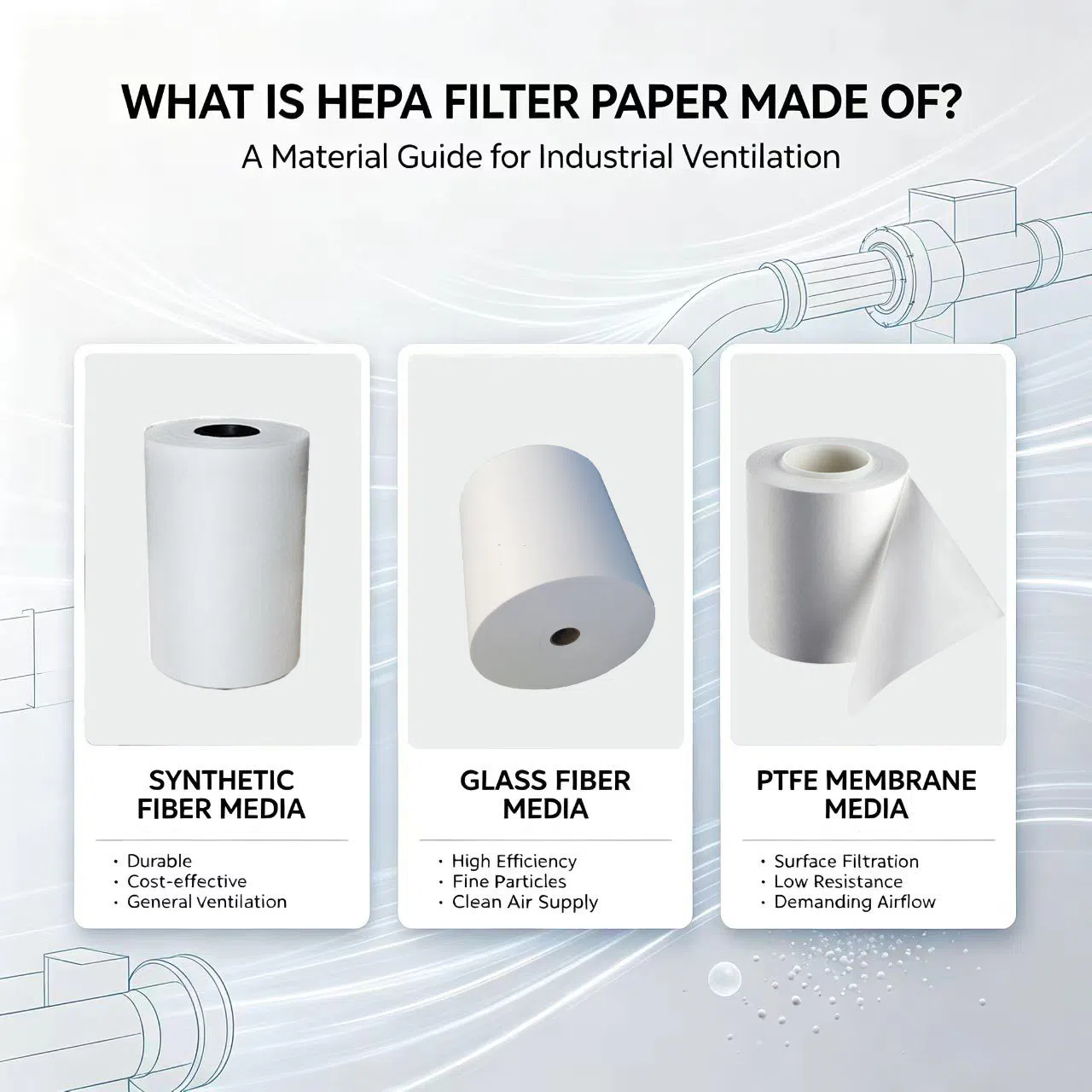
Glass fiber, synthetic fiber, and PTFE are three important material options used in high efficiency filtration. Each has different characteristics and can be suitable for different filter designs and operating conditions.
For filter manufacturers and OEM buyers, understanding these differences can make it easier to select the right HEPA filter media for a specific application.
What Materials Are Used in HEPA Filter Media?
HEPA filter media is designed with a fine fiber structure that can capture very small airborne particles. Different fiber materials can be used to achieve the required filtration performance.
Glass Fiber HEPA Media
Glass fiber is one of the established materials used for high efficiency air filtration.
Glass microfiber can form a dense filtration structure with fine fibers, making it suitable for applications that require high particle removal efficiency.
Common characteristics include:
High filtration efficiency
Stable media structure
Good air filtration performance
Suitable for HEPA filter manufacturing
Available in different thicknesses and basis weights
Glass fiber HEPA media is widely considered when manufacturers need a balance between filtration performance and production cost.
However, glass fiber media must also be selected according to the pleating process, mechanical requirements, and operating environment.
Synthetic HEPA Media
Synthetic HEPA media is generally produced using polymer-based fibers. Different fiber structures and production processes can be used to achieve specific filtration and mechanical properties.
Compared with traditional glass fiber media, synthetic media can offer good flexibility and mechanical strength.
Typical characteristics include:
Good mechanical strength
Flexible media structure
Good handling performance
Suitable for different filter designs
Potential for customized media structures
Synthetic HEPA media can be considered when mechanical strength, flexibility, and handling performance are important factors in filter production.
PTFE HEPA Media
PTFE is another high performance material used in advanced filtration applications.
PTFE-based filter media can provide very high filtration efficiency while maintaining favorable airflow characteristics when properly designed.
PTFE also has strong resistance to moisture and many chemicals, which can make it suitable for demanding operating environments.
Typical characteristics include:
Very high filtration efficiency
Low resistance potential
Excellent moisture resistance
Excellent chemical resistance
Good long term stability
The exact performance of PTFE filter media depends on the membrane or fiber structure, thickness, airflow, and finished filter design.
Glass Fiber vs Synthetic vs PTFE: Key Performance Differences
There is no single material that is best for every HEPA filter.
The most suitable material depends on the required filtration efficiency, airflow, pressure drop, mechanical strength, operating environment, and manufacturing process.
Material Comparison
Performance Factor | Glass Fiber | Synthetic Fiber | PTFE |
|---|---|---|---|
Filtration Efficiency | High | Application dependent | Very high |
Air Permeability | Media dependent | Media dependent | Media dependent |
Pressure Drop | Media dependent | Media dependent | Potentially low |
Mechanical Strength | Moderate | Generally good | Good |
Moisture Resistance | Application dependent | Generally good | Excellent |
Chemical Resistance | Application dependent | Material dependent | Excellent |
Flexibility | Moderate | Generally good | Application dependent |
Typical Application | HEPA filtration | Air filtration and HEPA applications | High performance filtration |
The table provides a general comparison. Actual filter performance depends on the specific media construction and testing conditions.
Filtration Efficiency
Filtration efficiency is usually one of the first specifications considered by filter manufacturers.
Glass fiber can provide high filtration efficiency because of its fine fiber structure. Synthetic media can also achieve high efficiency through optimized fiber structures and media design.
PTFE can provide very high filtration efficiency and is often considered for applications where high particle removal performance is a major requirement.
However, material type alone does not determine the final filtration efficiency of a finished filter.
Other factors include:
Fiber diameter
Media thickness
Media density
Filter area
Airflow
Pleat configuration
Filter construction
Pressure Drop and Air Permeability
Pressure drop is another critical consideration.
A filter with excessive pressure drop may require more energy to maintain the required airflow. Therefore, filter manufacturers need to balance filtration efficiency and airflow resistance.
Pressure drop depends on more than the material itself. Media structure, thickness, airflow, filter area, and finished filter design can all affect the result.
For this reason, buyers should compare filter media using the same test conditions rather than comparing isolated pressure drop numbers.
Mechanical Strength and Moisture Resistance
Mechanical strength is particularly important during filter production.
The media may be exposed to:
Continuous tension
Pleating
Folding
Cutting
Adhesive application
Filter assembly
Transportation
Synthetic media is often considered when flexibility and mechanical strength are important.
Glass fiber can provide excellent filtration performance but should be matched carefully with the production process.
PTFE can provide strong moisture and chemical resistance, making it suitable for applications where environmental resistance is a major concern.
How to Choose the Right HEPA Filter Media?
The right HEPA filter paper should be selected according to the requirements of the finished filter rather than the material name alone.
Choose Glass Fiber When
Glass fiber HEPA media may be suitable when:
High filtration efficiency is required
Traditional HEPA media technology is preferred
A balance between performance and cost is important
The production process is compatible with glass fiber media
Consider Synthetic Fiber When
Synthetic HEPA media may be considered when:
Mechanical strength is important
Flexible media handling is required
The filter design requires specific synthetic fiber characteristics
Production efficiency is an important consideration
Consider PTFE When
PTFE filter media may be suitable when:
Very high filtration efficiency is required
Low pressure drop is an important consideration
Moisture resistance is critical
Chemical resistance is required
The application requires high performance filter media
Why Choose an Experienced HEPA Filter Paper Supplier?
For filter manufacturers, consistent media quality is essential for stable production.
As a professional HEPA filter paper supplier, we provide glass fiber, synthetic, and PTFE filter media options for different filtration requirements and filter designs.
Our support includes:
Consistent media quality
Flexible roll widths and specifications
Technical data for product evaluation
Samples for production testing
OEM and bulk supply
Technical support for media selection
We focus on matching the filter media to the customer's actual application, filter design, and production requirements.
Looking for the Right HEPA Filter Media?
Choosing between glass fiber, synthetic fiber, and PTFE depends on your filtration requirements, filter design, and operating environment.
Send us your target efficiency, airflow, media thickness, roll width, and application. Our team can recommend a suitable HEPA filter media, provide samples for testing, and prepare a quotation for your project.
Welcome to contact us toRequest a Quote | Get a Sample


