
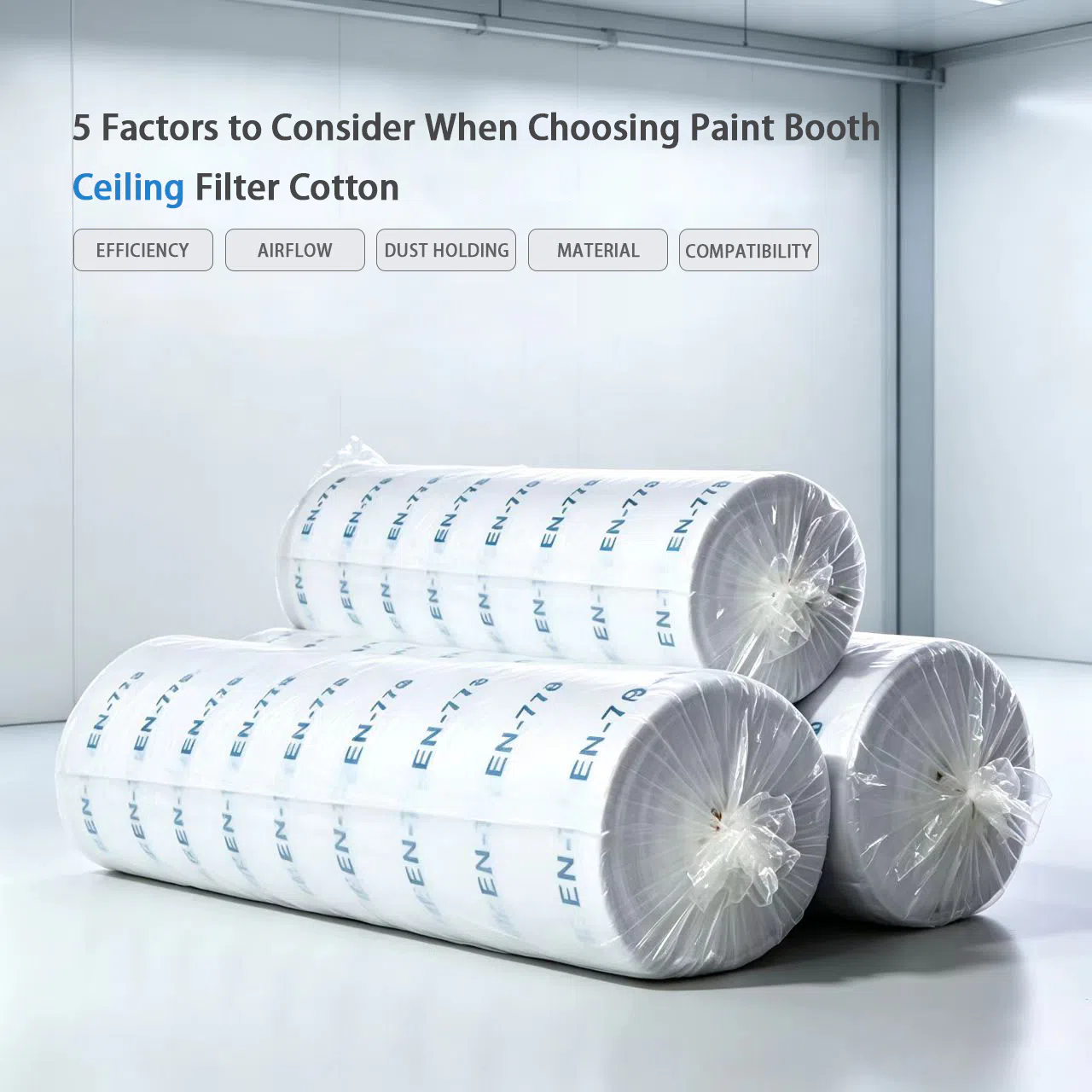
Understanding Paint Booth Ceiling Filter Cotton
What Is Paint Booth Ceiling Filter Cotton?
Paint booth ceiling filter cotton is installed in the supply air filtration system of a paint booth to help remove airborne particles before the air enters the working area. It plays an important role in controlling airborne contamination in coating environments.
Dust and other airborne particles can affect coating surface quality. Selecting suitable ceiling filter media helps support cleaner supply air, while proper installation and ventilation system design are also essential to maintaining consistent working conditions.
Ceiling filters and paint arrestor filters serve different purposes. Ceiling filters treat incoming supply air, while paint arrestor filters are generally used on the exhaust side to capture paint overspray. They should not be selected as interchangeable products.
5 Factors to Consider When Choosing Ceiling Filter Cotton
1. Filtration Efficiency and Performance Requirements
Filtration efficiency is one of the first specifications buyers should review. However, the required efficiency depends on the application and the filtration requirements of the overall system.
When comparing products, check:
- The specified filtration efficiency
- The applicable test method and test conditions
- The filtration requirements of the paint booth
- Compatibility with the existing filtration stages
2. Initial Resistance and Airflow Requirements
Initial resistance affects the operating conditions of an air filtration system. Buyers should consider filter resistance together with the required airflow, available filtration area, and fan capacity.
3. Dust Holding Capacity and Maintenance Considerations
Dust holding capacity is another specification to review when selecting ceiling filter cotton. It provides a reference for evaluating the filter's dust retention performance under the applicable test conditions.
Dust holding capacity alone cannot determine actual service life. Filter replacement intervals depend on operating conditions and the maintenance requirements of the system.
For practical maintenance, buyers should consider:
Monitoring filter differential pressure
Checking airflow performance
Inspecting the filter for damage or improper installation
Establishing replacement criteria based on system requirements
A suitable maintenance plan helps reduce unexpected filter changes and supports stable operation.
4. Material Structure, Thickness, and Weight
Ceiling filter media can differ in fiber structure, material treatment, and outlet-side construction. These characteristics should be considered alongside the required filtration performance and installation conditions.
Snyli provides two kinds of materials:
Resin-Treated Composite Structure
Made with long-staple, heat-bonded synthetic fibers designed for resistance to breakage
Processed with water-soluble resin through multiple manufacturing procedures
Uses a three-dimensional resin impregnation process
Features high-density polyester fabric on the outlet side
Progressive-Density Fiber Structure
Made with long-staple, heat-bonded synthetic fibers designed for resistance to breakage
Features a progressively denser fiber structure
Designed with an emphasis on air permeability and airflow distribution
5. Installation Compatibility and Operating Costs
Even when filter specifications meet the project requirements, installation compatibility still needs to be checked.
Before purchasing, confirm:
Required filter dimensions and frame compatibility
Available installation space
Required airflow and filtration area
Filter supply format and customization requirements
Operating temperature and applicable safety requirements
Operating costs should also be considered beyond the initial purchase price. Filter replacement frequency, maintenance labor, fan energy consumption, and disposal requirements may all contribute to the overall cost.
Practical Selection Guide and SNYLI Solutions
What Information Should You Provide When Requesting a Quote?
To help your supplier identify suitable ceiling filter cotton specifications, prepare the following information:
Application: Automotive coating, furniture spray painting, or another process.
Dimensions: Required filter size and installation space.
Airflow: Required system airflow and available filtration area.
Performance: Target filtration efficiency and applicable test requirements.
Material: Preferred structure, weight, and thickness, if specified.
Operating conditions: Temperature and other project-specific requirements.
Supply format: Roll material, cut pieces, or other required formats.
Providing these details helps make product evaluation and quotation more efficient.
Find the Right Ceiling Filter Cotton with SNYLI
SNYLI supplies air filtration products and related filtration materials for industrial and commercial applications. For paint booth projects, we can discuss ceiling filter cotton specifications, available models, dimensions, and customization requirements based on your application.
Share your filter dimensions, airflow requirements, and target filtration performance with SNYLI to discuss a suitable filtration solution for your project!


