
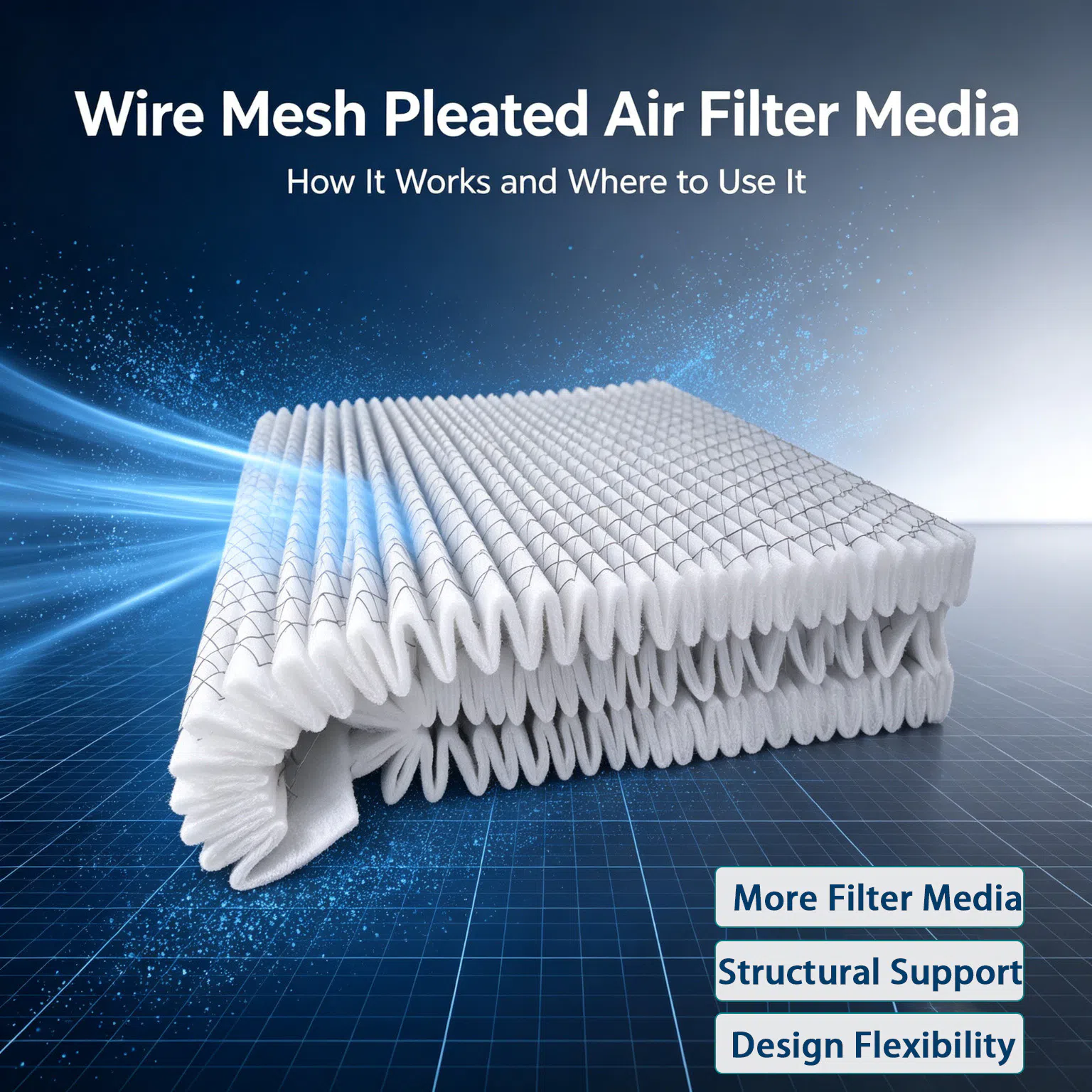
Choosing the right pre-filtration material is essential for maintaining stable airflow and effective particle removal in ventilation and air filtration systems. Wire Mesh Pleated Air Filter Media combines a pleated filter medium with a supporting mesh structure, making it an option for applications that require a shaped filtration surface and mechanical support. However, selecting suitable media involves more than comparing appearance or pleat count. Filtration performance, airflow resistance, operating conditions, and installation compatibility all deserve attention. This guide explains how this filter media works, where it can be used, and what buyers should consider before purchasing.
Structure and Working Principle
What Makes Up Wire Mesh Pleated Air Filter Media?
The performance and suitability of pleated filter media depend on the interaction between its filtration material and structural design. A typical wire mesh pleated construction include the following components:
Filter Media: The primary filtration layer, which captures airborne particles as air passes through the fibrous material. Fiber composition, density, structure, and manufacturing quality influence filtration performance and airflow resistance.
Pleated Structure: The filter medium is folded into a series of pleats. Compared with a flat sheet occupying the same face area, pleating can provide more filter media area, depending on pleat depth, spacing, and geometry.
Wire Mesh Support: The supporting mesh helps maintain the intended pleat shape and provides structural support. Its effectiveness depends on mesh design, material.
Frame or Mounting Structure: For finished filter products, a frame or mounting component may secure the filter in the equipment. Filter media supplied as rolls or sheets may not include this component.
The exact construction varies by product. Buyers should confirm whether they are purchasing filter media, a processed filter component, or a complete filter.
How Does It Capture Airborne Particles?
Pleated Air Filter Media removes airborne particles through several mechanisms associated with fibrous filtration.
As air flows through the medium, particles may be captured through:
Inertial impaction: Particles with sufficient inertia deviate from airflow streamlines and collide with fibers.
Interception: Particles following airflow paths pass close enough to fibers to make contact.
Diffusion: Very small particles undergo Brownian motion, increasing their likelihood of contacting fibers.
The relative contribution of these mechanisms depends on particle size, airflow velocity, fiber characteristics, and media structure.
It is important to distinguish structural design from filtration performance. A supporting mesh does not automatically increase filtration efficiency, and a greater number of pleats does not necessarily indicate better filtration. The actual performance should be evaluated using appropriate test data.
Key Benefits and Practical Considerations
A well-designed Wire Mesh Pleated Air Filter Media can offer practical advantages for air filtration projects, but its suitability depends on system requirements.
More filter media area
Pleating allows more media to be arranged within a given face area. Depending on the design, this can help accommodate the required filtration area within equipment space constraints. The actual benefit depends on pleat geometry and how effectively the available area is utilized.
Structural support
The wire mesh helps support the pleated configuration. This can be valuable when the filter design requires the medium to retain its shape during operation. However, overall durability also depends on the media strength, bonding method, and operating conditions.
Design flexibility
Different media materials, dimensions, and pleat configurations is available for different applications.
Where Is Wire Mesh Pleated Air Filter Media Used?
The application of Pleated Pre-Filter Media depends on the required filtration performance, equipment configuration, and environmental conditions.
HVAC Systems
Commercial ventilation and air conditioning systems may use pleated pre-filters to capture airborne particles before air reaches downstream components. Potential applications include air handling units, fresh air systems, and general building ventilation.
The appropriate filter grade and dimensions should be selected according to the system design and indoor air quality requirements.
Industrial Ventilation
Industrial ventilation systems may use pre-filtration to reduce the entry of airborne dust into downstream equipment. Application suitability depends on particle characteristics, dust concentration, temperature, humidity, and other operating conditions.
For environments involving oil mist, sticky contaminants, corrosive substances, or unusually high dust loads, additional compatibility assessments may be necessary.
Air Filtration Equipment
Pleated media can be considered for compatible filter assemblies and replacement projects.
For media supplied in rolls or sheets, the converting process and finished filter design should also be considered.
Multi-Stage Filtration Systems
In multi-stage filtration systems, a properly selected pre-filter can capture a portion of incoming particles before air reaches downstream medium-efficiency or HEPA filters.
This arrangement can help reduce the particle load on subsequent filtration stages. However, the degree of protection depends on the pre-filter's actual performance and the overall system design.
How to Choose the Right Wire Mesh Pleated Air Filter Media
Selecting suitable Wire Mesh Pleated Air Filter Media starts with understanding the actual operating requirements.
1. Define the filtration target
Identify the particle types, required filtration efficiency, and applicable test standard.
2. Confirm airflow and pressure drop
Provide the required airflow, filter face dimensions, and operating conditions. Compare initial pressure drop at comparable airflow rates. An unsuitable selection may increase system resistance or fail to meet the required airflow.
3. Verify dimensions and pleat configuration
Confirm length, width, thickness, pleat depth, pleat spacing, and available installation space.
For replacement projects, checking the existing filter dimensions and mounting arrangement can help prevent compatibility problems.
4. Select suitable media and support materials
Consider temperature, humidity, dust characteristics, and mechanical requirements. The filtration medium and supporting mesh should be compatible with the intended operating environment.
5. Evaluate maintenance and replacement requirements
Consider the expected dust loading, inspection schedule, replacement, and operating cost. Where available, review dust-loading test results and recommended final resistance criteria.
For customized projects, provide drawings, samples, or existing filter specifications to help verify the design.
Selecting the right Wire Mesh Pleated Air Filter Media requires balancing filtration performance, airflow resistance, structural support, and equipment compatibility. Pleated construction and supporting mesh can provide practical design benefits, but the right solution depends on the actual application.
SNYLI provides air filtration products and related solutions for different industrial and commercial requirements.
Contact SNYLI with your required dimensions, airflow, filtration target, and operating conditions to discuss a suitable filter media solution!


